
Why is water returning to the Beskydy forests? We went to find out
Published: Oct 13, 2025 Reading time: 4 minutes Share: Share an articleIn the middle of Indian summer, we and our partners from the LIFE WILL project set off for the Beskydy Mountains. Where we were given a tour of the largest infiltration measures ever implemented in the Czech countryside. During the visit, Miroslav Kubín from the Czech Agency for Nature Conservation and Landscape Protection showed us how we can protect our forests from drying out and our villages from flooding.
Mayors, municipal officials, and forest managers from the municipalities in our LIFE WILL – Water in the Landscape and Soil project joined us on an excursion to the Veřovice Hills. The trip was launched by Štefan Vaľo, an expert on water retention in forests. Using large-format images, he showed us how so-called “skid trails”—roads for hauling harvested timber—contribute to the drainage of forest land, especially on slopes.

Healthy soil can absorb up to 450 litres of water. But when it is compacted, its absorbency drops to as low as 20 %. The rest runs down the slopes and can threaten to form floods. And there are many such places with compacted soil in the Beskydy Mountains.

We headed out with soil expert Miroslav Kubín. He guided us around a site on land owned by Lesy ČR (Forests of the Czech Republic), where a number of infiltration pits interspersed with stabilising elements were created to prevent the forests from drying out.
How do such infiltration measures work?
The Beskydy forests—like a vast swathe of Czech, Moravian, and Silesian forests—suffer from drying and bark beetle infestation. Large amounts of rainwater are not absorbed by forest soil and then flow down forest roads and access routes into the valley. This water then often contributes to flooding.
The innovative "pit-dam-pit" method, developed by Štefan Vaľo, was first tested in Beskydy in 2020, in consultation with Lesy ČR and the AOPK ČR (Czech Agency for Nature and Landscape Protection). Miroslav Kubín, coordinator and co-author of the measure was, collaborated on its implementation with Václav Langer, an expert on forest ecosystems and water retention in the landscape, and Ondřej Brož, a forest worker.

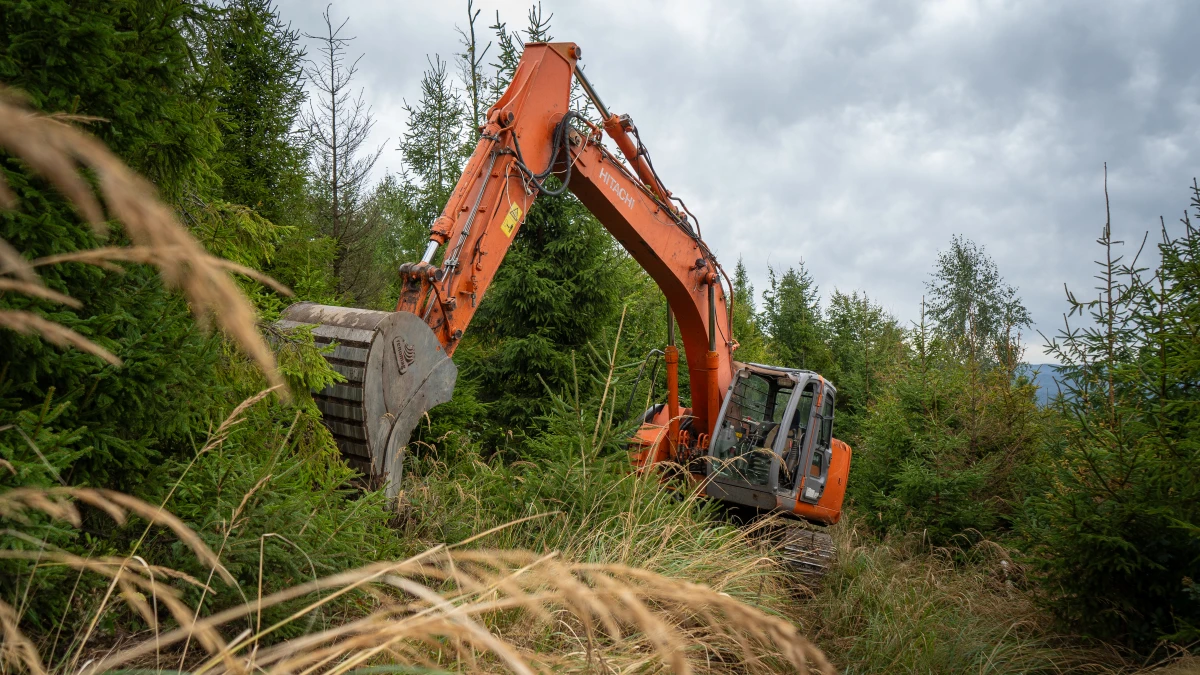
On forest roads and access routes, an excavator dug one infiltration pit after another into the compacted soil. The excavated soil was piled onto the original route of the road, which now forms a stabilising element. Through this measure, rainwater seeps into the soil and does not run down the slope.

This protects forests from drying (millions of litres of rainfall no longer run off), and also from overheating and erosion. In addition, it makes settlements in the valley safer from flooding. Additionally, more water means the creation of new habitats and, with them, greater species diversity. Today, a number of rare plant and animal species once again thrive here.

We're rooting for the excavator!
"It was nice, for once, to see that destruction can also be useful—in just a few minutes, a large excavator destroyed a forest road and restored its ability to absorb water," says Petr Nohava, manager of the LIFE WILL project, with a smile.
Our excursion to Beskydy impressed the representatives of the municipalities with the novel use methods of keeping water in the soil. Some of the participants, have shown an interest in similar measures in their own areas. For exaple Slavkov pod Hostýnem, having already begun planning new measures and we are keeping our fingers crossed, there will be more!
LIFE WILL – Water in the Landscape and Soil addresses the issue of drought and the impacts of climate change on the landscape. It is co-financed by the LIFE Programme—a European Union financial instrument supporting projects that increase the biological diversity of the landscape or its resilience to climate change—and the Czech Ministry of the Environment. Its goal is to increase the resilience of the population and agricultural landscape to climate change through the introduction of nature-based adaptation measures at the local level. We are achieving this goal by increasing the involvement of local actors and the public and their ability to implement measures for water retention in soil and landscape. We cooperate with Beleco, Sdružení místních samospráv ČR (the Association of Local Authorities of the Czech Republic) and Daphne - Inštitút aplikovanej ekológie (Daphne - Institute of Applied Ecology).


